
Solving Commercialization's Fragility Problem
The Hidden Dependencies That Destroy Otherwise Brilliant Companies

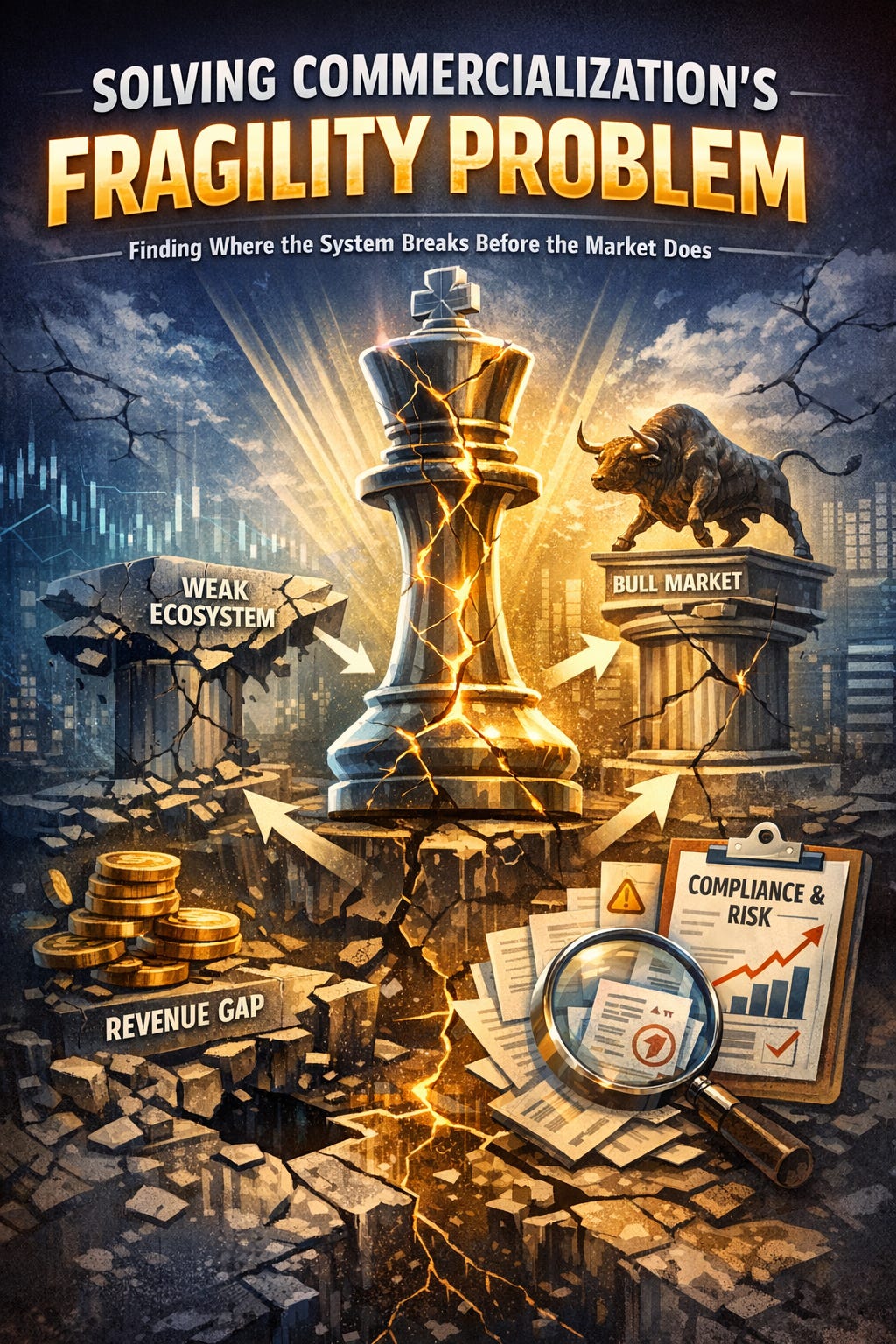
Most technically strong companies don’t fail because the product is weak.
They fail because the commercial layer never grows up.
I’ve spent the last decade inside blockchain infrastructure, digital finance, iGaming, and early AI ecosystems. Different industries, different regulatory environments, different capital cycles. But the pattern is remarkably consistent:
The product moves fast. The positioning stays blurry. The monetization logic gets assumed instead of designed.
And eventually, that gap shows up in the numbers.
I know this because I lived it.
The bet that made sense
At Glitter Finance, we identified a real problem early: moving capital across blockchain ecosystems was slow, fragmented, and expensive. Cross-chain bridging and settlement was an underserved niche with genuine demand. We built infrastructure around it, raised without difficulty during the bull cycle, and found real traction.
Then we evolved. We integrated Circle’s APIs and built fintech-grade cross-chain swaps via USDC. That wasn’t a minor technical update. It was a deliberate move toward institutional-level finance, toward the kind of dollar-denominated settlement infrastructure that serious players actually need. It opened conversations we couldn’t have had before. Counterparties who had ignored us started paying attention.
The problem wasn’t the idea. The problem was the timing assumptions baked inside it.
Stablecoin adoption wasn’t mature enough. Regulatory frameworks weren’t in place. Political will wasn’t aligned. The pool of users who were both willing and able to operate inside that system was a fraction of what we had projected. We had built something genuinely ahead of its time, which sounds like a compliment until you’re managing the runway implications of it.
Where it actually broke
Two strategic decisions compounded the problem.
We had anchored the business to two established blockchain ecosystems for our user base. Both had momentum, developer credibility, and institutional backing. The logic seemed sound at the time.
What we discovered was that the first ecosystem’s user base was structurally misaligned with our ideal customer profile. The people there weren’t the people we needed. And when the 2022 crypto collapse hit, that ecosystem took a severe blow. We were over-indexed to a partner whose fortunes we couldn’t control and hadn’t stress-tested our exposure to.
The second ecosystem created a different problem entirely. The build was significantly harder than anticipated because the mainnet was bogging down under load. Technical instability at the infrastructure level became our instability by extension.
The lesson wasn’t that these were bad ecosystems. The lesson was that we had designed for narrative instead of resilience. We chose ecosystem partners based on how the story sounded, not on how the system would behave under stress.
What that failure actually taught me
Systems need to be designed for resilience, not narrative.
It doesn’t matter how compelling the vision looks on paper if the underlying architecture, the user base, the partner dependencies, the regulatory assumptions, are fragile. The real work of commercial design is going toward the fragilities, not away from them. Finding where the system breaks before the market does it for you.
That reframe changed how I think about everything downstream: positioning, go-to-market, monetization, partnership selection. All of it.
What the market is now confirming
Here’s what makes this story worth telling beyond my own experience.
The infrastructure we were building at Glitter Finance, stablecoin-based cross-chain settlement, institutional-grade liquidity movement, is now being validated at scale by players with considerably more capital and distribution than we had. Stripe acquired Bridge. PayPal launched PYUSD. BlackRock is tokenizing funds on public blockchains. Stablecoin legislation is moving through Congress with bipartisan support for the first time.
We were building this before it was respectable. Before it was investable by institutional standards. Before regulators had a framework for it.
Being early and right is not the same as being successful. But it does mean the thesis wasn’t wrong. The fragility was in the timing assumptions and the ecosystem dependencies, not in the direction.
That distinction matters when you’re thinking about where the next wave of fragility lives, because it always lives somewhere.
How I now diagnose fragility
That experience reshaped how I evaluate commercialization. Today, when I assess a business, I look for fragility before I look for growth. Here’s what I stress-test:
Dependency exposure. Is the company over-reliant on a larger platform, ecosystem, or corporate partner? Is growth structurally tied to someone else’s cycle? Over-dependence on a bigger player can look like leverage. It can also be commercial vulnerability in disguise.
Cycle sensitivity. Is the revenue model over-indexed to a bull market? What happens if liquidity contracts or demand softens? If the model only works in expansion, it is not durable.
Revenue layer performance. Where exactly is performance under-delivering? Acquisition, conversion, retention, average revenue per user? Vague revenue weakness is unfixable. Layer-specific weakness is solvable.
Narrative and business development coherence. Is marketing telling the same story that business development is selling? If internal messaging diverges, the market feels it before leadership does.
Spend discipline. Is the organization spending for scale before validating resilience? Capital discipline is not conservatism. It is structural awareness.
Compliance and infrastructure longevity. Is compliance built for durability or retrofitted reactively? In regulated markets, compliance is not overhead. It is part of commercial architecture.
If these stress tests fail, growth is fragile regardless of how strong the product appears.
The product is not the business
Positioning requires deciding, explicitly, what you are in the market.
Not a “DeFi project.” Not a “cross-chain protocol.” Those descriptions carry zero weight in serious rooms. Early at Glitter Finance, we described ourselves in technical language because we were proud of the engineering. What we got back was polite confusion.
When we reframed around capital efficiency and liquidity coordination, around removing a specific economic friction rather than promoting architectural novelty, the conversations changed immediately.
Institutions don’t buy innovation. They buy predictability, reliability, and measurable commercial advantage. Clarity builds confidence. Confidence builds deals.
The discipline of regulated markets
Alongside the blockchain work, I spent several years operating inside iGaming environments across multiple regions. It’s an industry that gets dismissed in polite company but is one of the most commercially rigorous environments I’ve ever worked in.
Why? Because the margin for error is essentially zero. Regulatory compliance isn’t optional. Payment infrastructure has to work across wildly different jurisdictions. User trust is hard to earn and instantly destroyed. Retention isn’t a growth metric, it’s a survival metric.
Operating there forced a level of commercial discipline that I carried directly into fintech and blockchain. Onboarding friction becomes visible. Compliance becomes part of experience design. Payment rail reliability becomes strategic. Complex regulated markets don’t forgive sloppy commercial thinking. That’s not a warning. It’s the most useful accelerant I know for developing genuine commercial maturity.
Positioning is a strategic constraint, not a description
The most common mistake I see founders make is conflating description with positioning.
They explain what the product does. They never define what the company stands for.
Positioning requires saying no. It requires being willing to narrow. Who is this actually for? What problem does it eliminate, not reduce, but eliminate? Why now? Why us and not the existing alternative?
Without crisp answers to those questions, go-to-market efforts diffuse. Marketing pushes, sales improvises, product builds in isolation, and the market senses the misalignment before you do. I’ve watched this pattern repeat across blockchain, fintech, and iGaming environments. The symptoms look different. The root cause is almost always the same.
Brand is architecture, not aesthetics
Brand isn’t a logo or a color system. It’s narrative coherence.
In advisory work with Seed and Series A companies, I regularly encounter technically excellent platforms where the internal team describes what they do in five different ways. That fragmentation erodes trust faster than a bad product review. Strong brand architecture means product, marketing, sales, and leadership are all telling the same commercial story, consistently, under pressure.
At Glitter Finance we experienced the inverse. As the market shifted and we evolved our positioning, internal alignment lagged. Different team members were still selling the old story while leadership was building toward a new one. That gap is invisible until it shows up in a sales conversation at exactly the wrong moment.
Global markets punish lazy assumptions
Working across Africa, the Middle East, CIS markets, Southeast Asia, Europe, and North America taught me one practical truth: commercial logic doesn’t travel automatically.
Payment behavior varies. Regulatory tolerance shifts. Trust signals are deeply local. What reads as credibility in London reads differently in Lagos or Riyadh.
Carrying full P&L responsibility changes how you see the world. It replaces narrative optimism with structural realism and forces honesty about cost structure, capital allocation, runway, and exposure. You stop asking whether this sounds compelling. You start asking whether this survives pressure.
Where fragility is now emerging
The patterns that broke parts of the blockchain infrastructure cycle are now clearly visible in AI commercialization, and most people building in that space aren’t looking for them yet.
Undifferentiated positioning. Monetization assumptions built on projected scale. Platform dependencies selected for narrative fit. User bases assumed rather than validated.
The technology is genuinely transformative. The commercial layer is years behind it.
We were building cross-chain settlement infrastructure before stablecoins were respectable. Before regulators had a framework. Before institutions would take the meeting. The market eventually caught up and validated the direction, but not before the cycle extracted its toll.
The same dynamic is playing out in AI right now. The question worth asking isn’t whether the technology is real. It is whether the commercial architecture around it is built for resilience or just for the current moment of enthusiasm.
That gap is where the next stress test will occur.
What I actually do
My early career was in direct B2B sales, full cycles, technical environments, translating engineering specifications into commercial value. That foundation matters more than anything that came after. Pipeline isn’t a marketing function. It’s structured credibility compounding over time.
Stepping into CMO and CEO roles, the frame widened. Marketing became coordination. Positioning became economic design. Operations became risk management. Compliance became strategic advantage.
When those functions operate in alignment, growth compounds quietly. When they operate independently, growth is fragile and expensive.
Across blockchain, fintech, iGaming, and emerging AI environments, the work always centers on the same problem: bringing coherence to complex systems. Clarifying who the ideal customer actually is. Translating technical complexity into commercial relevance. Designing go-to-market motion around real buyer behavior, not assumed behavior. Stress-testing dependencies before scale. Building monetization logic that can absorb volatility, not just ride expansion.
Amplification without structure only magnifies fragility. Commercial coherence is the multiplier.
The bottom line
Markets have matured. Capital is more disciplined. Buyers are more skeptical. Regulators are more active.
The companies that endure aren’t the loudest ones. They’re the most structurally coherent.
Product maturity has to be matched by commercial maturity, or whatever growth you generate is borrowed time.
The most important question in commercialization isn’t how compelling the vision is. It’s where does this break, and have we solved for that before the market finds it for us.
That’s the work. And it’s the only kind that compounds.
Stay Connected
If this writing and way of thinking resonates, I share ongoing notes, examples, and breakdowns of this system in public on my LinkedIn. You can follow or connect with me there to see how your brand will grow in real time.