
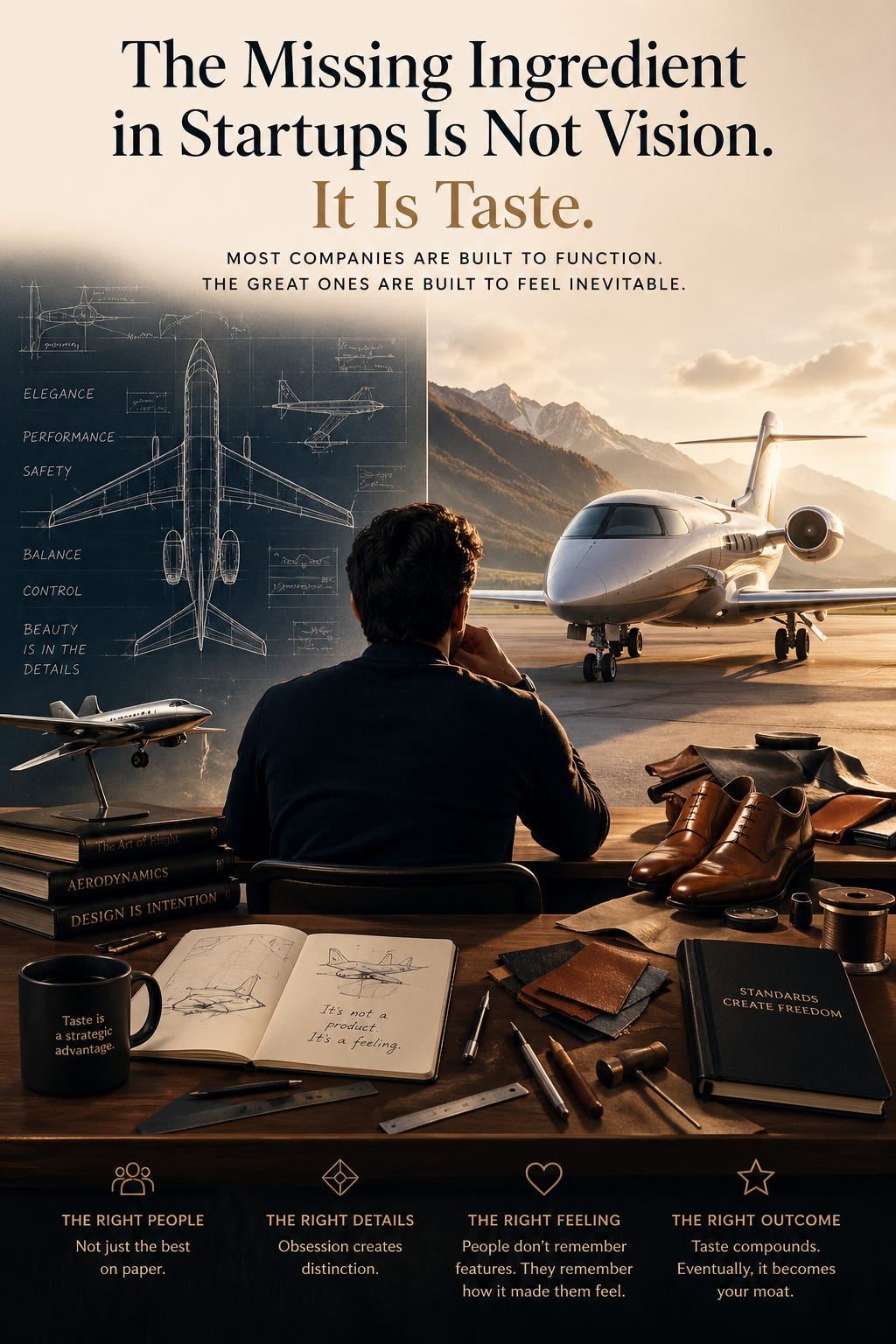
The Missing Ingredient in Startups Is Not Vision. It Is Taste.
Most companies are built to function. The great ones are built to feel inevitable.

There is a popular myth in business.
If you have passion, work relentlessly, hire smart people, and execute hard enough, success will eventually follow.
It sounds convincing.
But it is incomplete.
Many founders do all of those things and still build companies that nobody truly cares about.
The product works.
The team is capable.
The market is real.
The numbers look respectable.
Yet nothing about it feels magnetic.
Nothing feels memorable.
Nothing feels destined to win.
Why?
Because startups do not become exceptional through effort alone.
They become exceptional when a founder brings something rarer than ambition to the table.
Taste.
Taste Is Not Decoration
Most people misunderstand what taste really means.
Taste is not logos.
Taste is not fonts.
Taste is not choosing the latest color palette.
Taste is the ability to know, with uncomfortable precision, what is right and what is almost right.
It is knowing when something works technically but fails emotionally.
It is sensing when a hire looks impressive on paper but is wrong for the mission.
It is recognizing the difference between good enough and world class long before the market can explain it.
Early on, taste is almost invisible.
Later, it becomes obvious.
The Airplane Founder Problem
Imagine an engineer who loves airplanes.
They decide to build an aviation startup around their own designs.
That is already a strong beginning.
They understand mechanics.
They understand systems.
They understand the dream.
Then they do what founders are usually taught to do.
They raise capital.
They hire engineers.
They build prototypes.
They move fast.
But the real question comes next.
Are these engineers capable of building the exact airplane you have in mind?
Not an airplane that simply flies.
Not an airplane that passes inspections.
Not an airplane that looks acceptable in a pitch deck.
The airplane.
The one that climbs with confidence.
Turns with grace.
Feels stable under pressure.
Balances power with elegance.
Creates trust the moment someone steps inside.
That leap from functional to unforgettable is where many companies disappear.
Competence Is Common. Alignment Is Rare.
There are competent people in every industry.
Competent coders.
Competent marketers.
Competent designers.
Competent operators.
Competence can help you build something that works.
Alignment helps you build something that matters.
A competent engineer solves the brief.
An aligned engineer understands the founder’s standard before it is fully spoken.
A competent designer delivers assets.
An aligned designer helps shape identity.
A competent executive improves margins.
An aligned executive improves margins while protecting the soul of the product.
That distinction matters more than most founders realize.
Many companies hire for credentials.
Great companies hire for resonance.
Why Some Brands Feel Alive
Two companies can spend similar amounts of money.
They can use similar materials.
They can hire similarly smart people.
They can sell into the same market.
Yet one feels sterile, while the other feels alive.
Why?
Because one was assembled.
The other was authored.
Ferrari understands this deeply. Performance is not just horsepower. It is steering feel, throttle response, sound, posture, tension, and confidence.
Great Italian shoemakers understand it too. Leather is never just leather. It is texture, aging, scent, movement, shape retention, and dignity over time.
The best products are filled with invisible decisions.
Most customers cannot name those decisions.
But they can feel them immediately.
Why Many Startups Feel Generic
Most startups are optimized like spreadsheets.
Large market.
Clear roadmap.
Solid hires.
Efficient funnel.
Fundraising narrative.
Those are useful ingredients.
But if nobody at the center has uncompromising standards, the result is often forgettable.
Products people use but do not love.
Brands people notice but do not trust.
Experiences people try but rarely return to.
Markets are full of competent companies.
There is always room for a company with soul.
The Founder’s Real Job
Many founders think their main job is to manage people and allocate resources.
That is only part of it.
The deeper responsibility is to define excellence so clearly that others can build toward it.
What must feel effortless?
What must feel premium?
What must feel fast?
What must never be compromised?
Which details matter even if nobody applauds them?
Which shortcuts would permanently damage the identity of the company?
The answers to those questions become culture.
Then they become product.
Then they become reputation.
Then they become moat.
The Hidden Source of Unicorns
Some billion dollar companies win because timing was favorable.
Some win because distribution was strong.
Some win because capital was abundant.
But the brightest companies often win because they feel inevitable.
That feeling usually traces back to a founder who cared deeply about details others dismissed as irrational.
The sound.
The speed.
The wording.
The texture.
The trust.
The people.
The standard.
They did not just want to build a company.
They wanted to build this company.
That level of specificity is difficult to compete with.
Questions Every Founder Should Ask
Do I know exactly what I want, or only vaguely what success looks like?
Are my hires impressive, or are they deeply right for the mission?
Does my product merely function, or does it create conviction?
What details would a true master obsess over that I currently ignore?
Am I building something efficient, or something inevitable?
Final Thought
Most startups do not fail because they lack effort.
They fail because they lack standards.
The market may reward speed in the short term.
But over time, people gravitate toward products built with care, precision, and identity.
Markets forget competent companies.
They remember signatures.
And signatures are written by founders with taste.
If this resonates, and you are thinking about how to better align yourself with the right path to capital, feel free to connect.
I spend most of my time working with founders on how to match who they are with how they raise, not just what they build.
You can find me here: Connect on LinkedIn